Commercial Waste Blackfriars: Health & Safety Policy
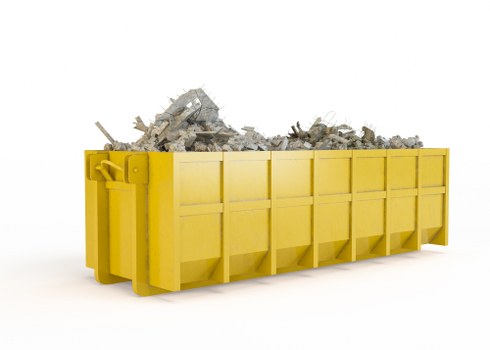 Commercial Waste Blackfriars is committed to protecting the health, safety and welfare of all employees, contractors and members of the public impacted by our commercial rubbish operations. This policy outlines the framework and standards that govern safe working practices across our service area, covering collection, transport, transfer and short-term storage of business waste. Our objective is to prevent injury and ill health through robust management systems, clear responsibilities and continuous improvement while delivering efficient commercial waste services in an operationally demanding environment.
We adopt a risk-based approach to rubbish collection Blackfriars activities, ensuring hazards are systematically identified, assessed and controlled. Senior management provide leadership and resources to maintain a safe workplace; operational managers implement safe systems of work and supervisors ensure compliance on the ground. Risk assessments and method statements are used to set controls, and where risks cannot be eliminated we apply substitution, engineering controls and administrative measures in that order to reduce exposure.
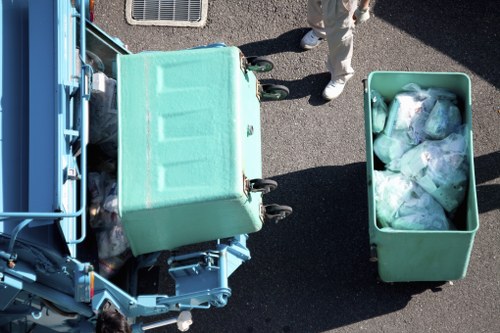 Training and competence are central to our safety culture: all staff receive induction, job-specific training and periodic refresher sessions tailored to the demands of our commercial waste services Blackfriars. This includes instruction on manual handling techniques, safe use of lifting gear, vehicle safeguarding, segregation of waste streams and the correct use of personal protective equipment. Supervised on-the-job coaching and documented competency records ensure crews remain capable of performing tasks safely and effectively.
Operational Controls and Safe Systems
Safe systems of work underpin routine and non-routine tasks; these include permit-to-work processes for complex operations, traffic management at premises and depots, and defined exclusion zones for mechanical lifting. We require segregation and secure containment for hazardous or potentially infectious waste to protect crews and the public. Vehicle loading is managed to prevent overloading and to ensure stability during transit; collection routes are planned to minimise crew exposure to traffic and to reduce unnecessary manual handling.
 Maintenance of vehicles and equipment is a critical control: pre-shift checks, scheduled servicing and an active defect reporting regime keep our fleet safe and reliable. Only trained technicians carry out maintenance and repairs, and all mechanical lifting devices undergo statutory inspections. Where mechanical aids are available they are used to reduce manual handling risk, and supervisors ensure that defective equipment is taken out of service immediately.
Emergency preparedness is integrated into every operation: crews are trained in spill response, first aid and fire precaution measures and carry appropriate kits and communication devices. Incident reporting and investigation follow a consistent process to identify root causes and implement corrective actions. We record and analyse incidents and near misses to identify trends and to drive preventive measures that strengthen our commercial rubbish operations.
Worker Protection, Monitoring and Improvement
PPE is provided in line with risk assessments and must be worn where hazards are present; commonly required items include gloves, high-visibility clothing, protective footwear and eye protection. We promote a safety-first culture where employees are empowered to stop unsafe work and to report hazards and near misses. Open reporting is encouraged and incidents are investigated without blame to foster learning and improvement across crews and management.
 Manual handling guidance and ergonomic controls reduce musculoskeletal injury: where practicable, mechanical aids and team lifts are specified and work-rest patterns are monitored to prevent fatigue. Supervisors assess task frequency, weight and posture and adapt work assignments to control exposure. For collections involving sharp or hazardous materials, specific handling protocols minimise contact and ensure secure containment during transport and transfer.
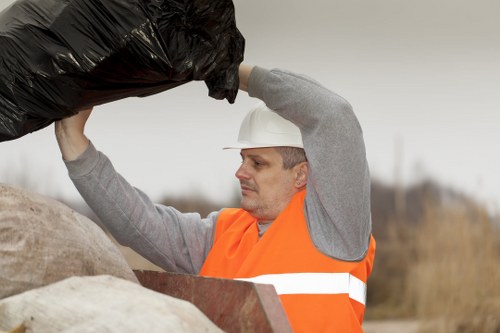 Performance is monitored through leading and lagging indicators including training completion rates, near-miss reporting frequency, incident rates and corrective action closure times; regular audits and toolbox talks ensure standards are maintained.
- Clear responsibilities are assigned across roles
- Competence is maintained through ongoing training
- Continuous improvement is driven by review and audit findings
Roles and responsibilities are clearly defined: senior management set policy and resources; operational managers implement controls and monitor performance; employees follow procedures and report hazards. This policy is reviewed at least annually and whenever significant changes occur to equipment, processes or waste streams to ensure continuing suitability and effectiveness. While this document sets out the overarching health and safety commitments for commercial waste Blackfriars operations, it complements site-specific procedures and task-based risk assessments that contain the detailed controls required for particular locations and activities.
The company expects everyone to contribute to a safe workplace. By combining strong leadership, competent people and practical controls, we aim to provide reliable and safe commercial rubbish services that protect people, property and the environment. The policy is endorsed by senior leadership and communicated to all employees, and is supported by training, supervision and monitoring to ensure it is implemented consistently across our service area.
